
New Kingdom Egypt
Dynasty XVIII-XX
During the New Kingdom, a newly reunified Egypt began to expand into an empire. To combat the Hyksos to the north and the Kushites to the south, Egypt led successful military campaigns. The empire became large enough that there were three functioning capitals: Thebes was the religious capital, Memphis was the administrative capital, and the newly founded Pi-Ramses allowed for better access to the lands Egypt had recently gained in Asia.
Hatshepsut, one of Egypt’s most famous woman pharaohs ruled during this time, having taken over as regent for her too-young stepson. Within seven years, she successfully became the true pharaoh–not a queen, but a woman king of Egypt.
Pharaohs like Hatshepsut and Amenhotep III built huge temple complexes. The sprawling Karnak Temple in Thebes became a feature that nearly every monarch improved upon or added to. However, there was no longer an interest in pyramid-building. Instead, the royal family carved their tombs into the nearby hillside, creating the Valley of the Kings and the Valley of the Queens. Hatshepsut was the first to be buried in the Valley of the Kings.
Pharaoh Akhenaten (born Amenhotep IV) had little interest in foreign affairs, paying little attention to the growing Hittite threat to the north. This, and his own political and religious upheaval (moving the capital and changing the state religion) led to a brief period of instability.
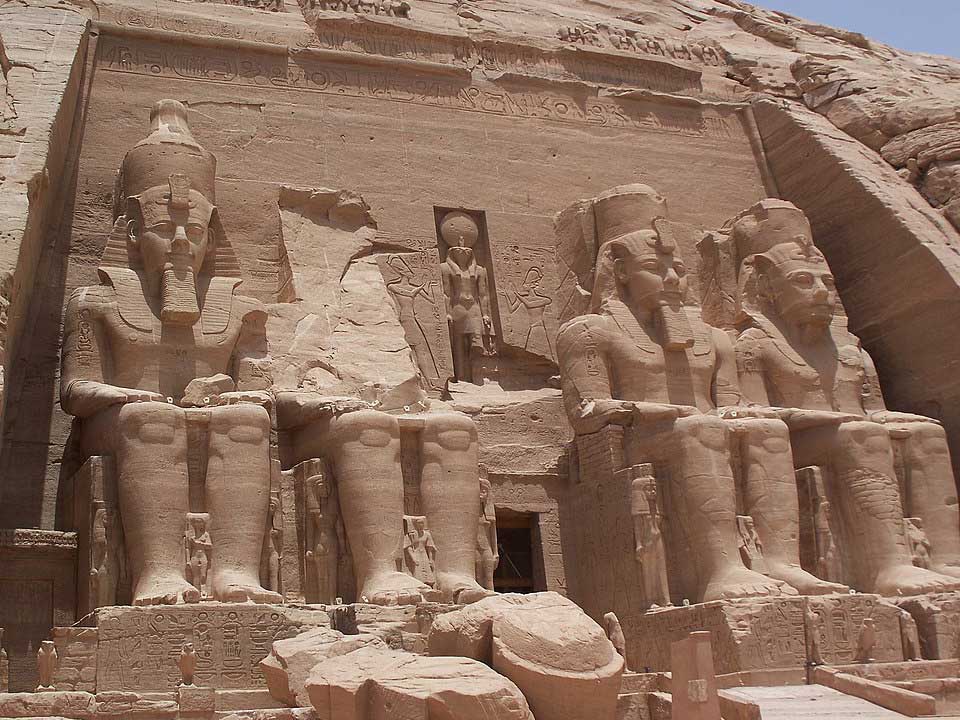
A few decades after Akhenaten’s death, Ramses I took the throne, ushering in a new, prosperous dynasty. His son, Ramses II (Ramses the Great), conducted 15 successful military campaigns in his 66-year reign. He was able to regain what Akhenaten lost, and then some, all while building monuments like Abu Simbel.
Over time, however, the strength of the central government began to wane yet again.

At-A-Glance
- Many famous names come from this period, including Hatshepsut, Akhenaten, Nefertiti, Tutankhamun, and Ramses II.
- Burials at Valley of the Kings and the Valley of the Queens began and ended in this period.
- The religious and political upheaval caused by Akhenaten damaged Egypt as an empire, perhaps permanently; the powerful efforts of later pharaohs like Ramses II never quite returned Egypt to the height of its empire.